
Menopausal Hormone Therapy Linked to Faecal Incontinence
According to a new research, the use of menopausal hormone therapy increases the risk for faecal incontinence (FI) (also known as bowel incontinence) to a relatively moderate degree. FI is more common among community-dwelling women and usually ranges from 7% to 15%. The risk of faecal incontinence indeed increases with age, but most of the women feel too embarrassed to discuss the problem with their doctors.
However, the additional FI risk caused by the hormone therapy is not much larger – 26% for former users and 32% for current users as compared to those women who had never gone through the menopausal hormone therapy.
But it could significantly increase the problem in women who are already suffering from mild leaking because of factors like neurological problem like multiple sclerosis, diabetes or previous multiple vaginal births with anal spinchter trauma. The faecal incontinence risk in such women is usually worse.
But the advantages of hormone therapy may be more significant than the FI risks. If a woman is living a healthy life, except suffering from severe menopausal vasomotor symptoms. The recent study also recommends that it’s necessary to use the hormone replacement therapy for the shortest duration. As the longer you are off hormone therapy, the more the  risk decreases. While the women who are long term hormone therapy are more prone to the risk of  faecal incontinence. Thus, whenever a patient visits a clinic for hormone therapy, we should set an appropriate time for treatment.
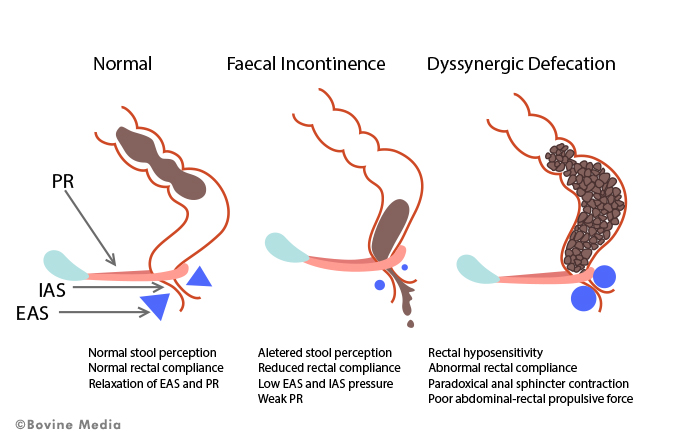
Sometimes even short term use of hormone therapy is related to a high risk of FI. In contrast with women who had never used hormone therapy. The risk was 1.22 when used for 1 to 5 years, 1.24 for 6 to 10 years, and 1.32 when used for more than 10 years.
Females who had quit the hormone therapy 2 or 3 years before the survey did not have a high risk for FI as compared to those who had discontinued recently.
First prospective study on Menopausal Hormone therapy tied to Faecal incontinence
The first prospective study of the subject was conducted in 1976 commonly known as Nurses’ Health Study. At that time various questions about the type and frequency of FI were asked to 121,701 women who were registered nurses aged 30-55.
The questions were again added in 2008 to the biennial follow-up questionnaires, when the population for analysis were 55,828 women who were postmenopausal. Most of them did not report having the problem at that time. While women who reported to have suffered from faecal incontinence at least every month. These women usually suffer from the impaired ability to control the release liquid or stool at a desired time. However, incontinence of solid stool is a more severe problem.
When asked about the duration of use of menopausal hormone therapy. 12.2% of the women reported to be suffering from FI in 2008-2012 – 48% of them were having inconsistency in liquid. 40% in solid and 12 % in both liquid and solid.
The age-adjusted risk ratios for FI were 1.26 in previous hormone therapy users and 1.32 in current users as compared to the never-users. The risks estimated were, however, mildly reduced after adjustment for other risk factors of faecal incontinence. These risk factors include body mass index, cholecystectomy, smoking, hypertension, parity, neurologic disease, diabetes. Other factors related to hormone exposure, such as age at menopause, oral contraceptive use, age at menarche, type of menopause and ovulatory duration.
When compared with the women who use oestrogen-only preparations. The multivariate risk ratio for FI in women who use both oestrogen and prostgestin formulations was 1.37.
Mechanism between Hormone therapy use and Faecal incontinence
It is difficult to understand the exact mechanism between hormone therapy and faecal incontinence. But it is probably associated with the Anorectal oestrogen Receptors.
The relationship between hormone therapy and faecal incontinence is believed to be similar to the relationship between hormone therapy and urinary incontinence. This is because the tissues around the urethra and vagina are oestrogen sensitive in the case of urinary incontinence. As a result, many females develop vaginal dryness when oestrogen levels get depleted naturally.
But when the risk of FI increases in women with age, the oestrogen level in women declines and it can be improved by replacing the oestrogen.
The same pattern is observed with urinary incontinence. Which not only worsens with the menopause, but also with menopausal hormone therapy. The excess exogenous oestrogen in your body may cause downregulation of the tissues.
However, it is important for doctors to let their patients know that it is normal to develop the problem of faecal incontinence as they start aging. Women must not feel embarrassed about talking about it with their doctors. As it will help them to get effective treatment.
Monalisa Touch Treatment
The alternative to a number of Menopausal symptoms particularly vaginal laxity is the Mona Lisa touch. The Mona Lisa touch has no association with faecal incontinence and in fact may improve this by improving vaginal tone.


Social


Categories
Recent Posts
Menopausal Hormone Therapy Linked to Faecal Incontinence
According to a new research, the use of menopausal hormone therapy increases the risk for faecal incontinence (FI) (also
All about the Menopause
Menopause is commonly referred to as the years in a woman’s life, when her ovaries gradually start releasing fewer
All about Vaginal Atrophy
Vaginal atrophy or Atrophic vaginitis is an uncomfortable condition that can affect girls and women of all ages. In
Leave a Reply